
Bring World Class Coaches To Your Club

Earlier this summer I organised two rather unique events for football in Vancouver, which were hosted by Vancouver United FC. These were Train Like a Pro, for players, and Coach Like a Pro, for coaches.
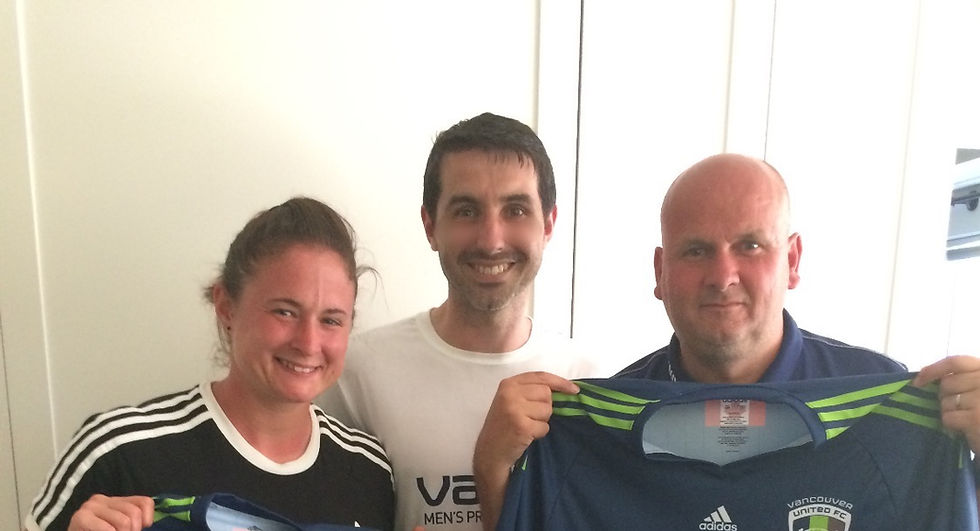
I was one of four coaches, each leading a squad of young players through a professional academy style training week. The players, aged 11-14, took part in four training sessions, and competed in a game under the watchful eyes of an AFC Pro Licence holder, and three UEFA A Licence holders.
Now, you may say that coaches representing large clubs and coming to foreign lands is nothing new, or unique; and you would be right. Just you look at how many large European clubs have a presence in China, India, America, Australia, Singapore…I could go on. This however, was not your one-size-fits-all coaching clinic. Each of the four squads were predominantly made up by a team in that age group e.g. we had one squad that had 11 of 15 players from one team present. It made sense for the team coaches to provide information to the guest coaches that could help them shape the team for the upcoming season. So, the guest coaches were provided with the formation the team would play, the style of play the team coach wanted to instil, and specific weaknesses the coach would like to be worked on. The guest coaches took this information, and developed sessions specifically for these groups; refining it down to create core themes which were worked on across the week.
The feedback from coaches watching these sessions was overwhelmingly positive. Our club coaches, mostly parent coaches, spoke effusively to me about the layers of progressions made during exercises, the detail and specificity of instruction, and how good it was to see a different way of coaching and organising training sessions. There were, as with anything subjective, people who unimpressed, or disappointed with certain aspects; including a coaching style. For me, that should have been a positive. I truly believe that from every conference, lecturer, essay, interaction, or observation, that you can learn something. Sometimes it’s what to do, other times, it’s what not to do. But that all stems from your mindset.
The start of the second event overlapped the end of training week, and focussed on coach education. Club coaches were invited to come along and watch the finale of the training week – the games. The coaches then took part in a presentation I gave on ‘Communication in Training and Games’. The first question I posed to the group was, “What did you see and hear tonight?” The answers were fantastic! Parent coaches had a professional coach on one bench, and 3 parent coaches on the opposition bench. The parent coaches were, to some extent, a representation of themselves. Average Joes with Monday to Friday 9-5s who wanted to help out their kid’s team. But the difference was startling. The AFC Pro Licence holder, the Sydney FC Academy Director, the multiple time FIFA Technical Study Group member was quieter, more subdued. His coaching points were spaced out, and did not turn into run on sentences that then turned into a running commentary of what every player was doing, or should be doing, with the ball at every moment of the game. The club coaches attending the Coach Like a Pro event recognised all this, and recognised some of this in themselves. It allowed the attendees to have an ‘out of body experience’ by viewing one of their own coach in a game, and then be placed directly into an environment that asked them to hold a mirror in front of themselves. One of the stories I told during this presentation was an account of something Guus Hiddink said, “Monday to Friday are my days. Saturday is the player’s day. Sunday is the family day.” My take away from this was that you should get all your coaching done during the week, and let the players play the game you have prepared them for. I understand this will be easier with professional players who train more than children, but I think the concept is applicable.
The following day, the guest coaches and I put on practical sessions covering topics including: goalkeeping, small sided games, scoring more goals as a team, and examples of UEFA Elite Youth A, and UEFA A Licence assessments. Finishing off with two more presentations, and a discussion on youth football in Vancouver, giving the attendees approximately 10 hours of coach education across 2 days. The attendees also received 25 handouts which included all 16 training sessions completed during the Train Like a Pro week. The cost of this 10-hour coach education seminar was $80CAD. The 4 90-minute training sessions, and 1-hour game which players took part in cost $140CAD.
These aren’t ridiculous costs for players or coaches to pay for interacting with elite level coaches. We aren’t massively famous coaches who cost a fortune to help develop coaches and players alike. This isn’t out of the realm of possibility for the average youth club to organise and do.
The reason that I wrote this piece was to give you an insight into how your club could engage with, and host a player development week, and coach education seminar for yourselves. Over my years coaching, I have heard enough people complain that the regional association or national body were not doing enough to develop players or coaches by holding an annual conference. I always asked why couldn’t it be done by the clubs?
There are many great coaches out there, who are ready, willing and able to help in the development of your club. Reach out to them via LinkedIn, Twitter, Instagram or via their club website. Yes, there will probably be costs involved with bringing coaches to you: housing them, feeding them, or paying for their time and expertise; but consider it. Reach out to people you’ve met on coaching courses to see who they know, speak to people at your regional or national association, and see if they have contacts to whom they can introduce you.
The coaches taking part in the Train and Coach Like a Pro week were: Kelly Cross, Sydney FC Academy Director and AFC Pro Licence holder. Laura Williamson, Greenock Morton FC's Head of Girl’s and Women’s Football, and UEFA A Licence holder. Brian Sproul, Scottish Youth Football Association Development Officer, and UEFA Elite Youth A Licence holder. And myself, Chris Steel, Vancouver United FC Academy Director, and UEFA A & UEFA Elite Youth A Licence holder.
(Originally published 3rd August 2017)


Comments